What to say in your first text to a land owner
The first text decides whether an owner replies, ignores you or reports you. Here's what works, why it works, and examples you can adapt for your own list.
The first text you send a land owner has one job: get a reply. Not a deal, not an appointment, not even a price. Just a reply.
That sounds obvious, but most investor texts are written as if they had to close the sale in 160 characters. They pack in the company name, a promise of cash, a "no fees" line and a link. Owners ignore them, carriers filter them, and some people report them as spam.
This guide breaks down what a good first text looks like, why it works, and how to follow up when the owner doesn't answer.
Think about who's reading it
Picture the person on the other end. Many rural land owners have held their parcels for years or decades. Some inherited the land and have never visited it. Plenty are older and wary of texts from numbers they don't know, because they get scam texts every week.
That reader is deciding in two seconds whether your message is a person or a pitch. Everything in a good first text helps it pass that test: a real first name, a detail only someone who looked at their property would know, and a question that's easy to answer.
The three parts of a strong first text
A first text that gets replies usually has three parts and nothing else:
- Who you are. Your first name, and that you buy land. Owners are more comfortable answering a person than a company.
- Which property you mean. The county, the road, or the acreage. This proves you're not a random blast and makes the message relevant.
- One easy question. Something they can answer in a word or two, like "Are you still the owner?" or "Would you consider an offer?"
Examples you can adapt
These are written for vacant land, but the same structure works for houses.
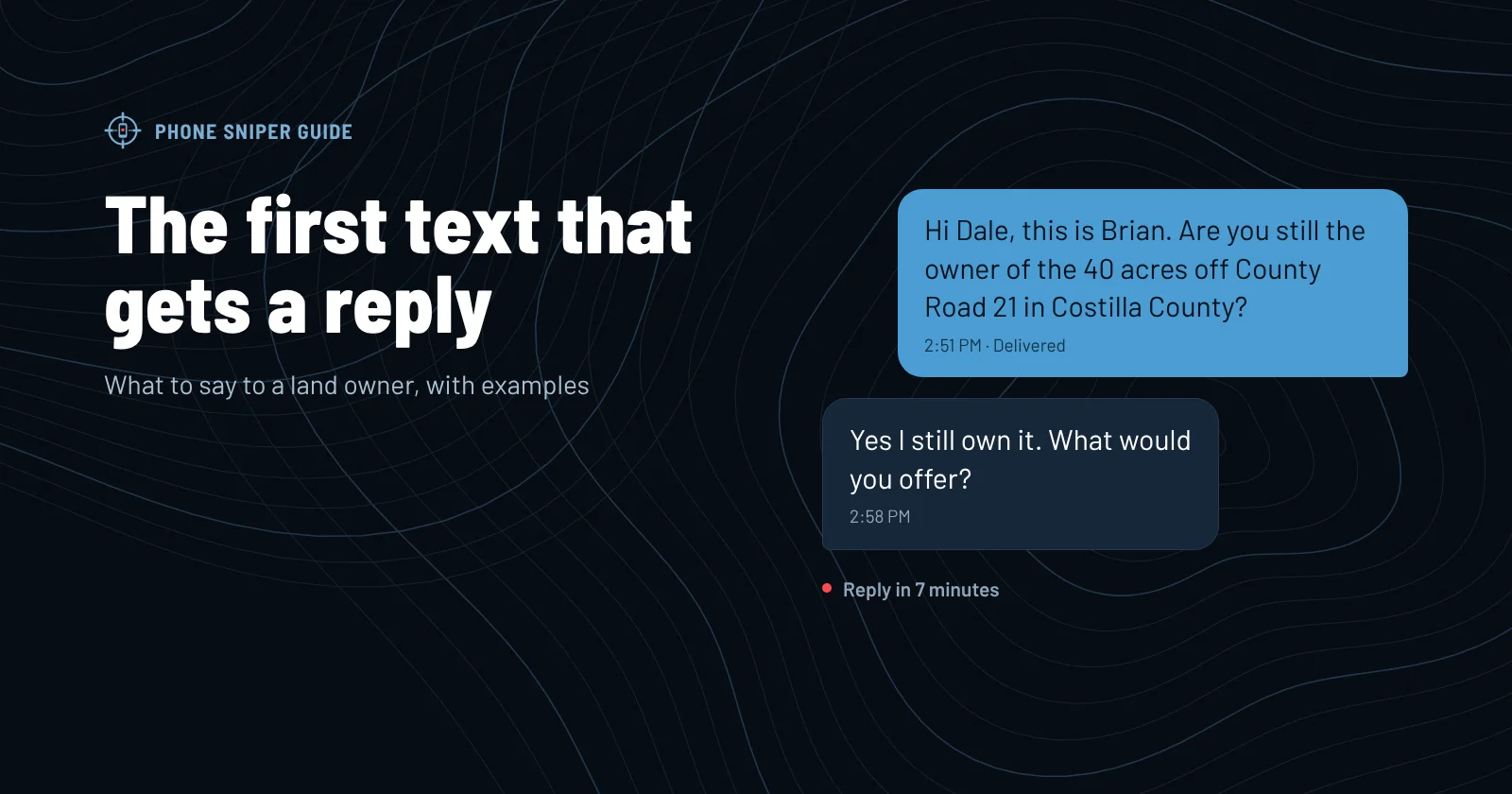
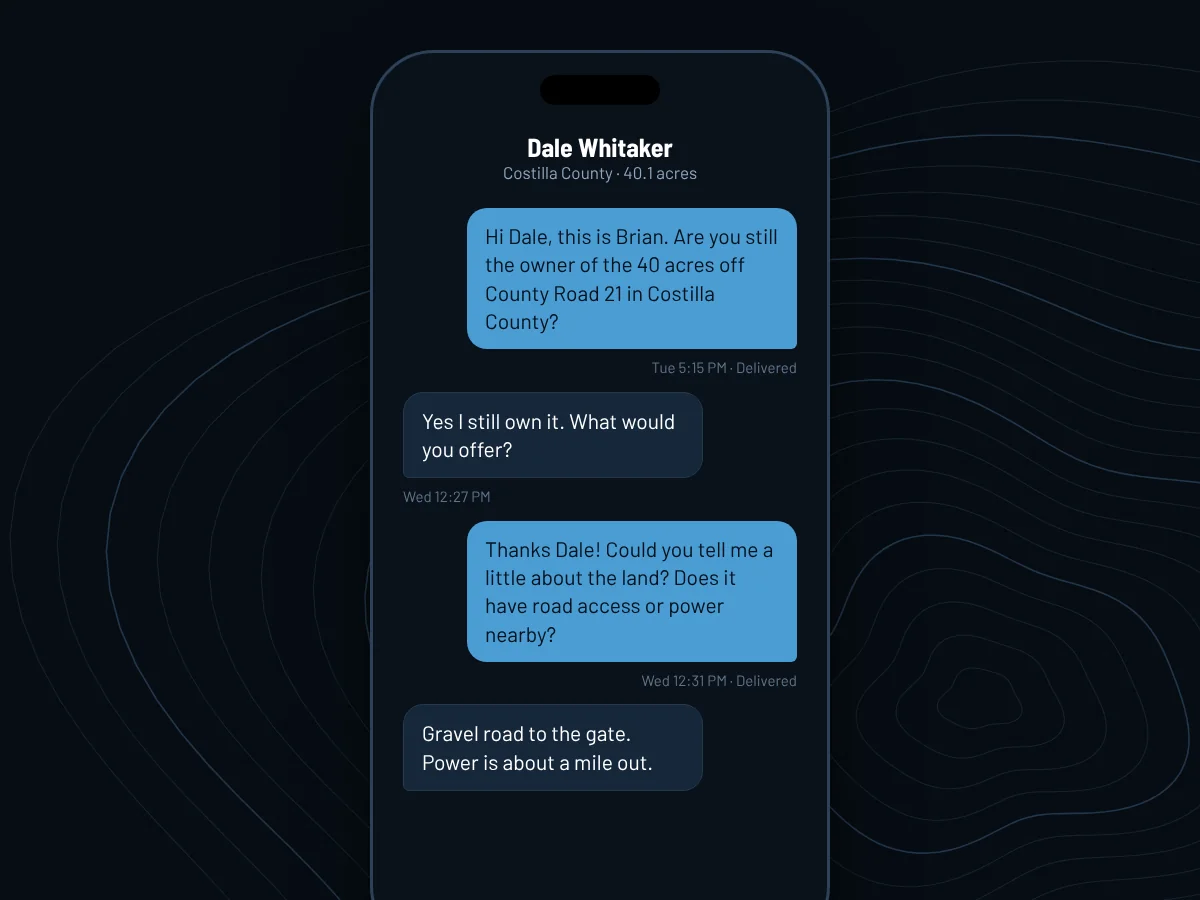
Hi Dale, this is Brian. Are you still the owner of the 40 acres off County Road 21 in Costilla County?
Hi Joyce, Brian here. I buy land in Las Animas County. Would you consider an offer on your 80 acres?
Hi, is this Rosa? I'm a local land buyer and wanted to ask if you'd ever sell your parcel in Costilla County.
Hi Travis, I'm Brian, a land buyer in southern Colorado. Is the 36 acres in Costilla County still yours?
Each one names a person, points to a specific property and asks one question. None of them mentions a price, uses a link or tries to sound urgent.
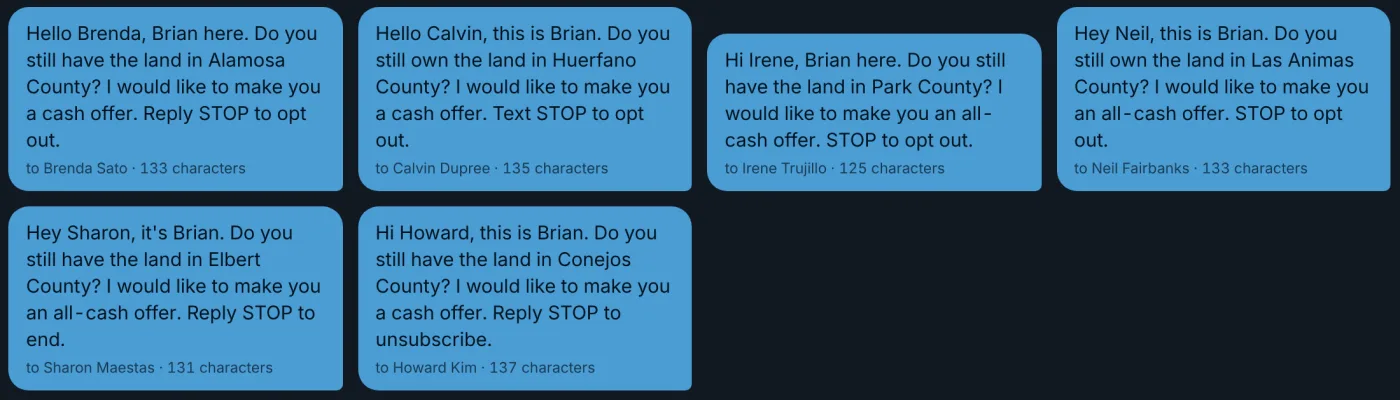
Many investors also add a short opt-out line, like "Reply STOP to opt out." It costs about 20 characters, tells the owner how to make you go away, and carriers look on it favorably. It's a good habit, especially on the first text.
Why "Are you still the owner?" works so well
It's the easiest possible question to answer. The owner doesn't have to decide anything or admit they're interested in selling. They just confirm a fact. Once they've replied, you're in a conversation, and the next question ("Would you consider an offer?") feels natural instead of pushy.
It also helps you clean your data. Skip-traced numbers are often wrong or outdated, and a "No, I sold that years ago" reply is useful too.
Openers for different situations
The same three-part structure adapts to almost any list. A few common cases:
Out-of-state owners. People who live far from their land often don't think about it much, and many are open to selling something they never visit. Mention where the land is, since it may not be top of mind:
Hi Karen, this is Brian. I buy land in southern Colorado. Would you ever consider selling your parcel in Costilla County?
Inherited land. Heirs sometimes co-own a parcel with siblings and aren't sure what it's worth. Keep it gentle, and don't assume they know the details:
Hi Mark, Brian here. I'm a local land buyer and noticed your family's 35 acres in Huerfano County. Is that something you'd consider selling?
Owners listed as an LLC or trust. Address the person if your skip trace found one, and mention the entity so they know which property you mean:
Hi Susan, this is Brian. Are you the right person to ask about the land owned by Sangre Ranch Trust in Huerfano County?
Houses instead of land. Use the street instead of the acreage. Street names make the message feel even more personal:
Hi Dave, this is Brian. I buy houses in Pueblo. Are you still the owner of the home on Elm Street?
Keep it to one text
A standard text message holds 160 characters. Go over that and the message is split into two or more parts. You pay for each part, and long messages look more like marketing.
There's a catch most people don't know about: a single emoji, or even a "smart" curly apostrophe pasted in from a word processor, switches the whole message to a different character set that only holds 70 characters per part. A message that fits easily can suddenly cost twice as much.
The fix is easy. Write your openers in plain text, leave out emoji, and if you write them in a word processor, check that the apostrophes and quotes are the straight kind before you paste them in.
What to leave out
| Leave out | Why it hurts |
|---|---|
| Links | They look like spam to carriers and owners alike. Save them for later in the conversation. |
| Prices | You don't know enough yet, and a number in the first text invites a quick no. |
| A pile of selling points ("CASH," "fast closing," "no fees") | One plain mention of an offer is fine. Stacking slogans marks you as a mass marketer. |
| Pressure ("act now," "limited time") | Owners feel pushed, and some report the message. |
| ALL CAPS and exclamation points | They read as shouting and trip spam filters. |
| Your whole company pitch | Nobody reads it. Your first name is enough for now. |
Vary the wording
If you send the exact same sentence to 3,000 owners, the carriers notice. Identical messages in high volume are a classic spam pattern, and they get filtered more.
Write four or five versions of your opener that say the same thing in different words, and rotate them. Change the greeting ("Hi Dale" / "Hello Dale" / "Dale, hi"), the way you introduce yourself, and the wording of the question. Keep the meaning and the property details the same.
Plan the follow-up before you send
Most owners won't answer the first text. That doesn't mean they're not interested. People are busy, they missed it, or they wanted to think about it.
A second, softer text three to five days later often gets more replies than the first:
Hi Dale, just following up on the land in Costilla County. Totally fine if now isn't the right time.
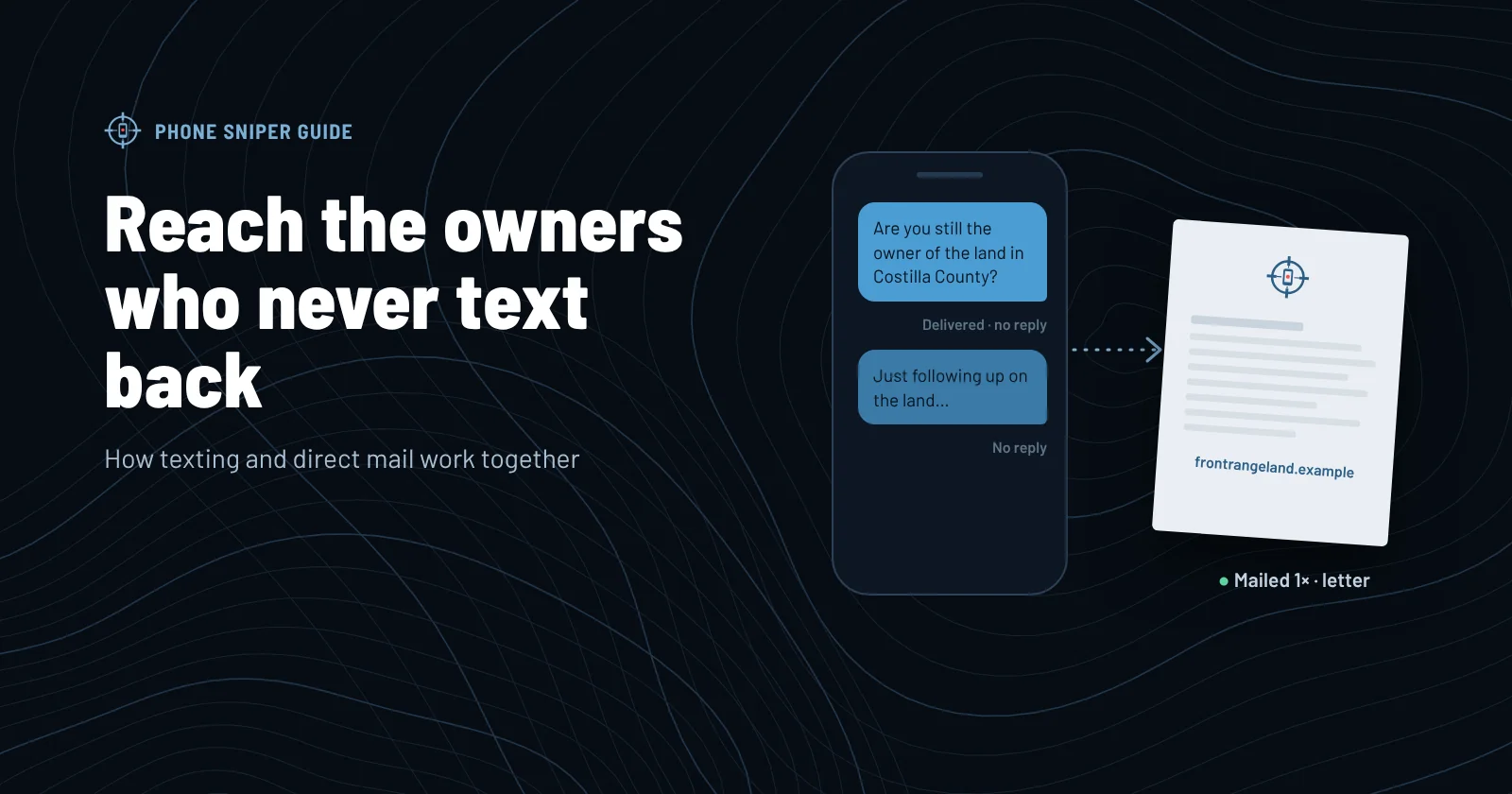
It's polite, it gives them an easy way to say no, and it reminds them you're a person. Stop after one or two follow-ups. If they haven't answered by then, a letter is often the better next step. See Texting and direct mail together.
When they reply, answer fast
A seller who texts back at 2 p.m. and hears from you at 2:05 is a warm lead. One who hears from you tomorrow morning has often cooled off, or already answered another investor.
Good second messages keep the conversation easy and move toward the property, not the price:
- "Thanks for getting back to me! Could you tell me a little about the land? Does it have road access?"
- "Great, thanks. Is there power or water nearby?"
- "Got it. Have you thought about what you'd want for it?"
Let them name a number first when you can. And if the answer is no, thank them and mark it in your records so they don't get your opener again next month.
Test, then keep what works
Don't guess which opener is best. Split your list, send two versions to similar owners, and compare reply rates after a few days. Change one thing at a time: the question, the way you introduce yourself, or the property detail you mention.
Keep notes on what you tried and what happened. Over a few campaigns, you'll know what works for your markets better than any template.
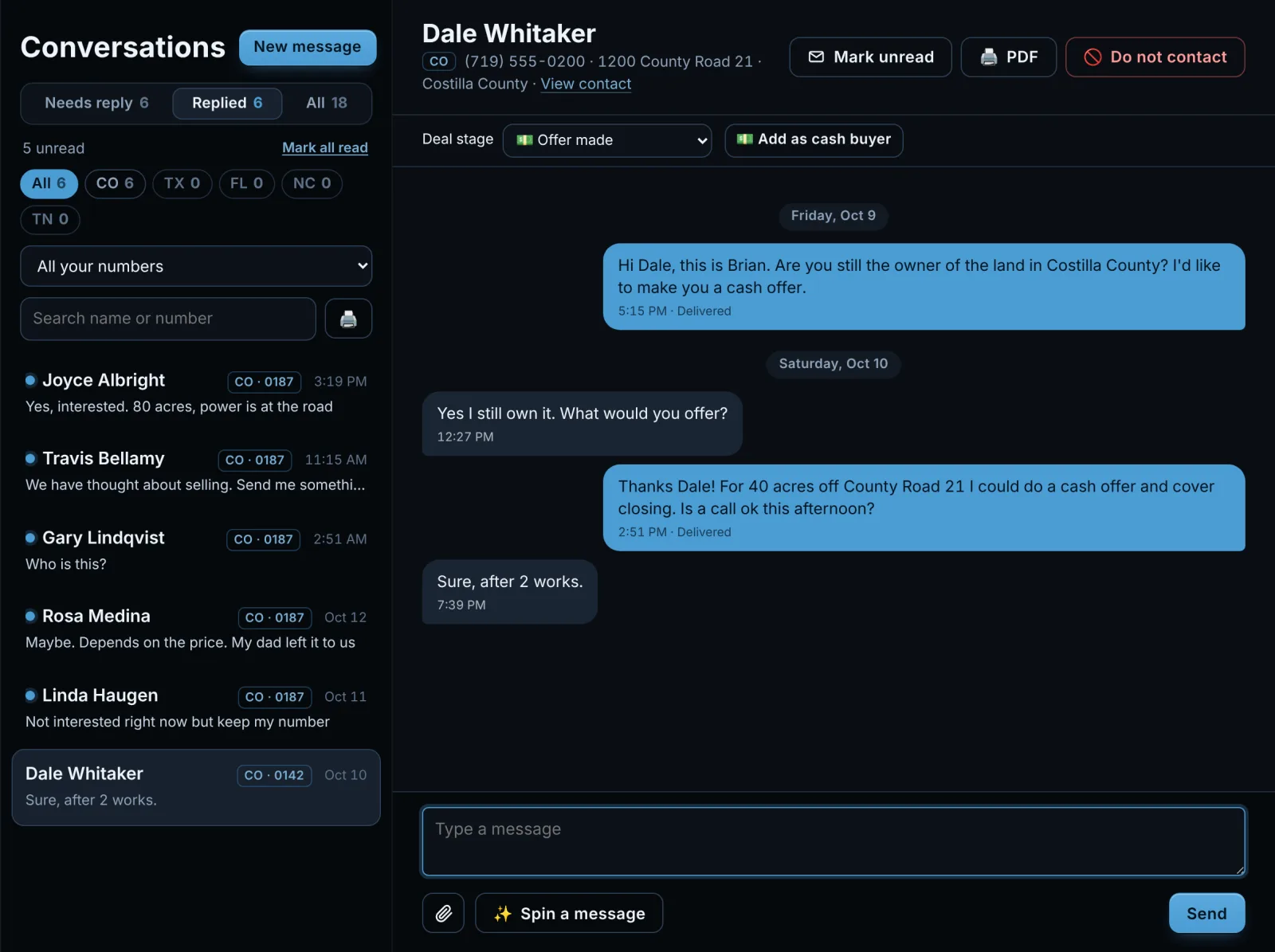
Phone Sniper is built around this kind of conversation. Spin rewrites your message for each owner, every reply lands in one inbox sorted by who needs an answer, and reply alerts on your phone tell you the moment a seller texts back.