TCPA texting rules for real estate investors: how to text owners without getting sued
One bad campaign can cost $500 to $1,500 per text. Here's what the TCPA and state laws say about texting property owners in 2026, and the habits that keep investors out of court.
Texting is the fastest way to find owners who want to sell. It's also the one part of your marketing that can turn a good month into a lawsuit. The federal Telephone Consumer Protection Act (TCPA) lets people sue for $500 per text, and up to $1,500 if the court finds the violation was willful. Do the math on a 2,000-text campaign and it's easy to see why class-action lawyers watch investor outreach so closely.
Nobody can make cold texting completely risk-free. What you can do is understand where the real risks are, build habits that remove most of them, and make sure the risks you keep are ones you chose on purpose.
What the TCPA actually covers
The TCPA is a 1991 federal law, but courts and the FCC treat text messages as "calls" under it. For investors, two parts matter most:
- Do Not Call rules. Telephone solicitations to numbers on the National Do Not Call Registry are off-limits without permission or an existing business relationship. Texts count.
- Automated messages. Texts sent with certain automated systems need the recipient's prior consent. The Supreme Court narrowed what counts as an "autodialer" in 2021, which helped, but several states have written their own, broader definitions since then.
There are also rules that apply no matter what: honor opt-outs within a reasonable time (no more than 10 business days), only contact people between 8 a.m. and 9 p.m. in their time zone, and identify who's texting.
The big question: is an offer to buy a "solicitation"?
This is the argument every investor eventually hears: the Do Not Call rules cover solicitations, and a solicitation means encouraging someone to buy or rent something. You're not selling anything. You're offering to buy.
Some courts agree:
- In Coffey and again in Aussieker v. Aghazadeh (E.D. Cal., July 2025), federal judges held that offers to buy property aren't telephone solicitations under the Do Not Call provisions, and dismissed the claims.
But it isn't a sure thing:
- In Helfrich v. Raven3 (S.D.N.Y. 2023), a home-buying company left prerecorded messages offering to buy homes. Its website called sellers "clients" and promoted the benefits of selling without agents, fees or paperwork. The court said that sounded like advertising a home-buying service, and let the case continue.
- No federal appeals court has ruled on the question yet, so a court in your area could go either way.
- Some state laws don't limit themselves to "sales," so the buying argument may not help you there at all.
The practical lesson: keep your first message about one specific property and one question. The more your texts and website read like a pitch for a service ("we make selling easy, no fees, no hassle"), the weaker the buying argument gets.
State laws are often stricter
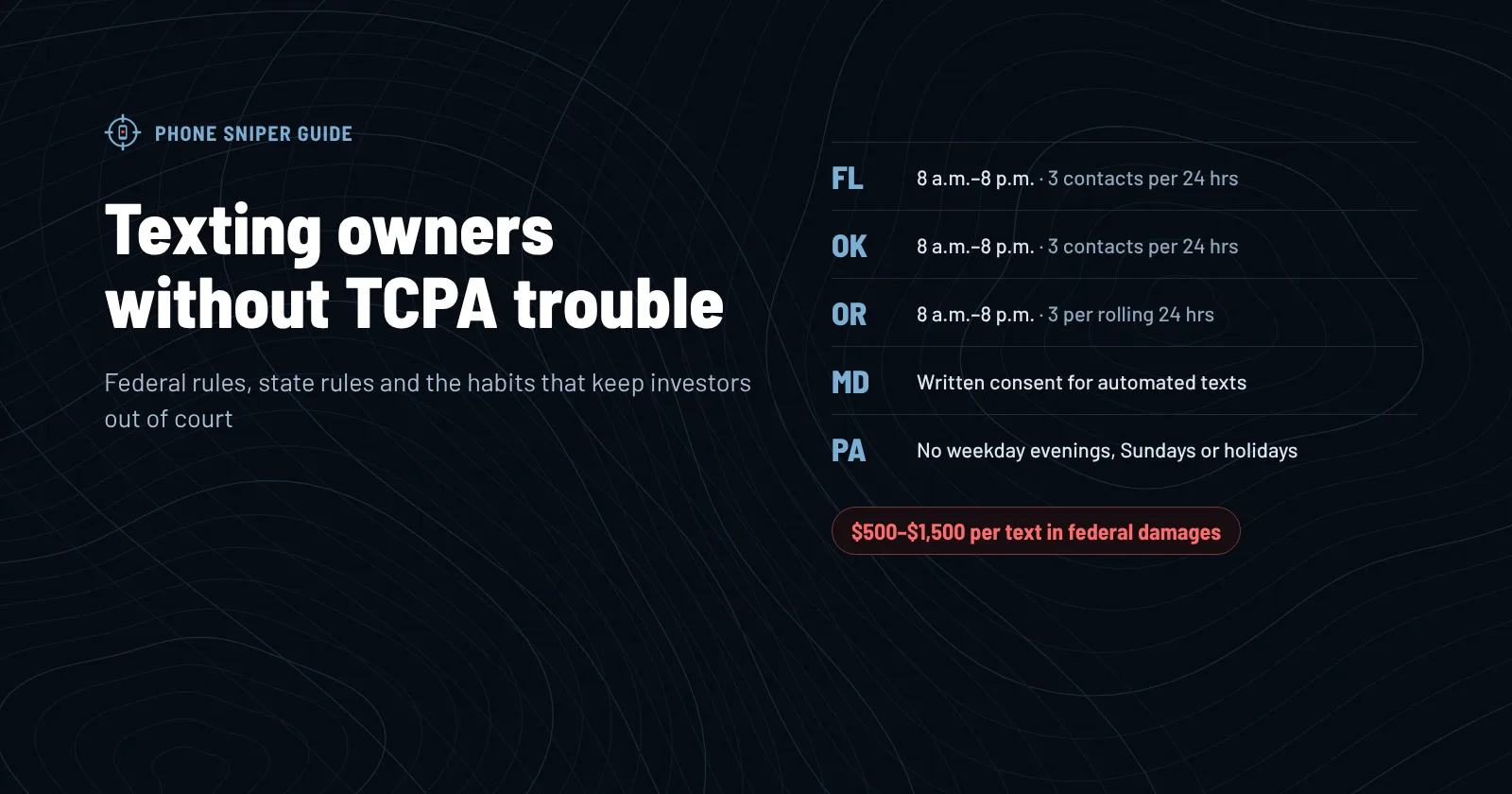
Since 2021 a wave of states have passed their own "mini-TCPA" laws. They apply based on where the owner lives, not where you are. A few examples:
| State | Hours (owner's time) | Other limits |
|---|---|---|
| Florida | 8 a.m. to 8 p.m. | No more than 3 contacts per 24 hours on the same subject. Senders get 15 days to honor a STOP before a lawsuit can be filed. |
| Oklahoma | 8 a.m. to 8 p.m. | No more than 3 contacts per 24 hours. |
| Oregon | 8 a.m. to 8 p.m. | No more than 3 per rolling 24 hours without an existing relationship. |
| Maryland | Not 8 p.m. to 8 a.m. | Written consent required for automated texts. |
| Pennsylvania | Not 7 p.m. to 9 a.m. on weekdays | No solicitations on Sundays or legal holidays. Registration may apply. |
| Texas | Federal hours | Telemarketer registration may apply. |
| Tennessee | 8 a.m. to 9 p.m. | Registration may apply. |
Sources don't always agree on the exact hours, and these laws change, so the safe move is to follow the strictest version and check the current text of the law in any state you text heavily. Registration requirements are worth a call to your attorney: some states exempt certain kinds of outreach, and the rules for buy-only texting aren't always clear.
Six habits that cut your risk
1. Check numbers before you text them
Run your list against the National Do Not Call Registry, state registries and known TCPA litigator lists before a campaign, and re-check at least every 31 days. Litigators are people who make a living suing over texts and calls. One of them on your list can be worth more to their lawyer than your whole campaign is to you.
2. Treat any opt-out as permanent, everywhere
STOP is obvious. So are "remove me," "don't text me," "wrong number" and a reply full of profanity. Under the FCC's rules, people can revoke consent by any reasonable means, so treat any clear "leave me alone" as an opt-out. Remove that number from every list and every channel, right away, and never re-add it from a new import.
3. Text only in the owner's local hours
Federal law says 8 a.m. to 9 p.m. in the recipient's time zone. Several states are stricter. A good default is 9 a.m. to 7 p.m. local time, Monday through Saturday. It keeps you inside almost every state's rules, and owners are more likely to answer then anyway.
4. One text per number, per day
Skip-traced lists are full of duplicates: the same cell phone shows up under the owner, a spouse, an LLC and a trust. Sending all of them in an afternoon breaks the 3-per-24-hours rules in some states and makes people angry everywhere. Merge duplicates and cap each number at one text a day across every list.
5. Keep the first message plain
Say who you are, ask one honest question about one property, and include a way to opt out. Skip "cash offer guaranteed," "free," "no fees, no hassle" and anything that reads like an ad. Plain messages get more real replies, and they keep you on the right side of the solicitation argument.
6. Keep records for five years
The TCPA's statute of limitations is four years. Keep every message you send, every opt-out and when you honored it, and where each number came from, for at least five. If you're ever accused, records showing you checked the registries, honored opt-outs and texted in the right hours are your best defense.
The strongest protection: consent
Every rule above is about lowering the risk of texting people who didn't ask to hear from you. The way to remove most of that risk is consent:
- The owner texted you first. A sign, a postcard or a website that says "text us" turns cold outreach into a reply.
- The owner filled out a form that clearly says you may text them, with a checkbox they ticked themselves.
- You saved the proof, with the date, the wording they agreed to and how they agreed.
Many investors run both: careful cold outreach to find motivated owners, and consent-based marketing (direct mail, signs, a website) that brings owners to them. When an owner reaches out first, the conversation is safer and usually warmer.
Things outside your texts
- Insurance. Most general business policies exclude TCPA claims. Ask a broker about coverage written for it.
- Your texting provider. Register your business texting (10DLC) and describe it honestly. Carriers block unregistered traffic, and registration creates a record that you're operating openly.
- An attorney. A one-time review of your messages, website and opt-out process costs far less than defending a single class action.
How Phone Sniper helps
Phone Sniper was built by a land investor who texts owners every week, so the guardrails are on by default and live on one Compliance page:
- Every number is checked before a campaign texts it, against the national and state Do Not Call lists and known TCPA litigators, and again every 31 days. Litigators are blocked and added to Do Not Contact.
- State rules follow the owner. Each owner is texted by the hours and rules of the state they live in, with no Sundays or federal holidays. You can tighten any state, set it to consent only, or turn it off. Maryland starts as consent only.
- Opt-outs in any wording. STOP, "remove me," "wrong number," "don't text me" and threats to sue all go straight to Do Not Contact, for texts, email and mail.
- One text per person, per day, across every list and every phone number they have.
- Consent on record. Mark owners who texted you first or gave written consent, with where it came from. They can be texted in consent-only states.
- US numbers only. Canadian and other foreign numbers are blocked, since those countries require consent first.
- Wording warnings. While you write a campaign, Phone Sniper flags "free," "guaranteed," "no fees," links, pressure words and a missing opt-out line.
- Every message, reply and opt-out is saved, so you have a record if you ever need one.
Software can enforce good habits, but it can't make legal decisions for you. Use these tools, keep your messages plain, and have an attorney look at your program once a year.
Sources: TCPAWorld on Aussieker v. Aghazadeh · National Law Review on Helfrich v. Raven3 · Tychron state texting laws guide · Kelley Drye on the FCC's opt-out rules